
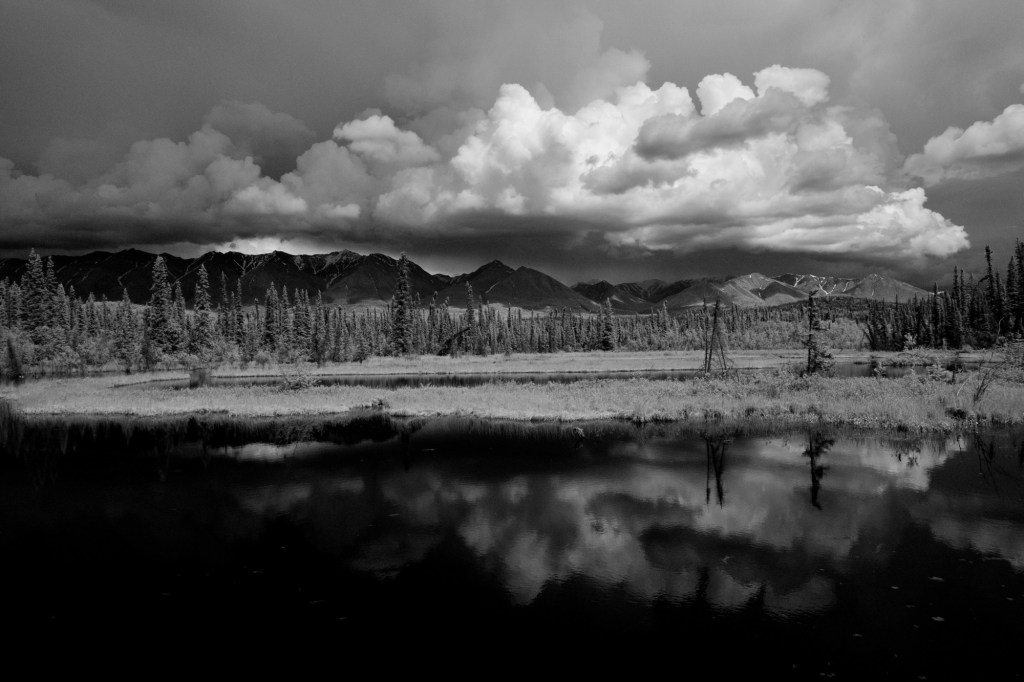
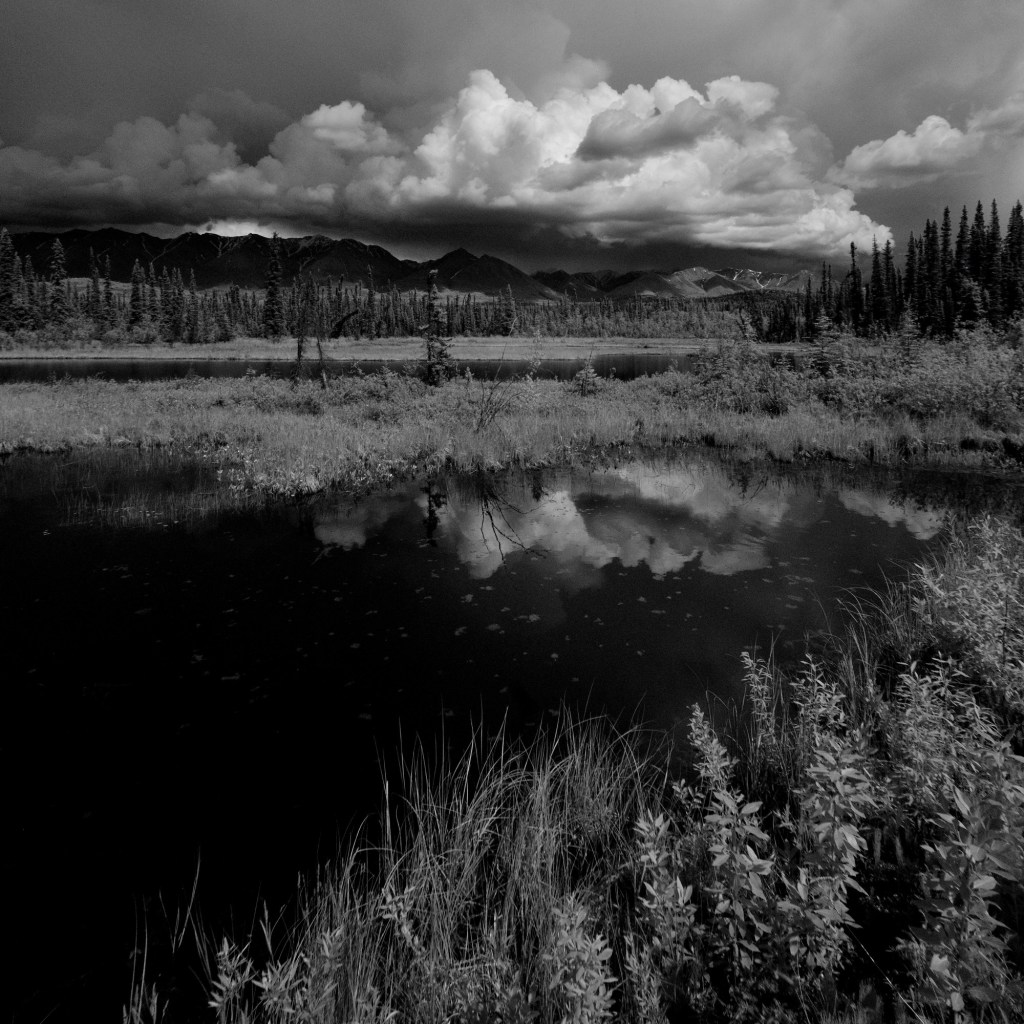
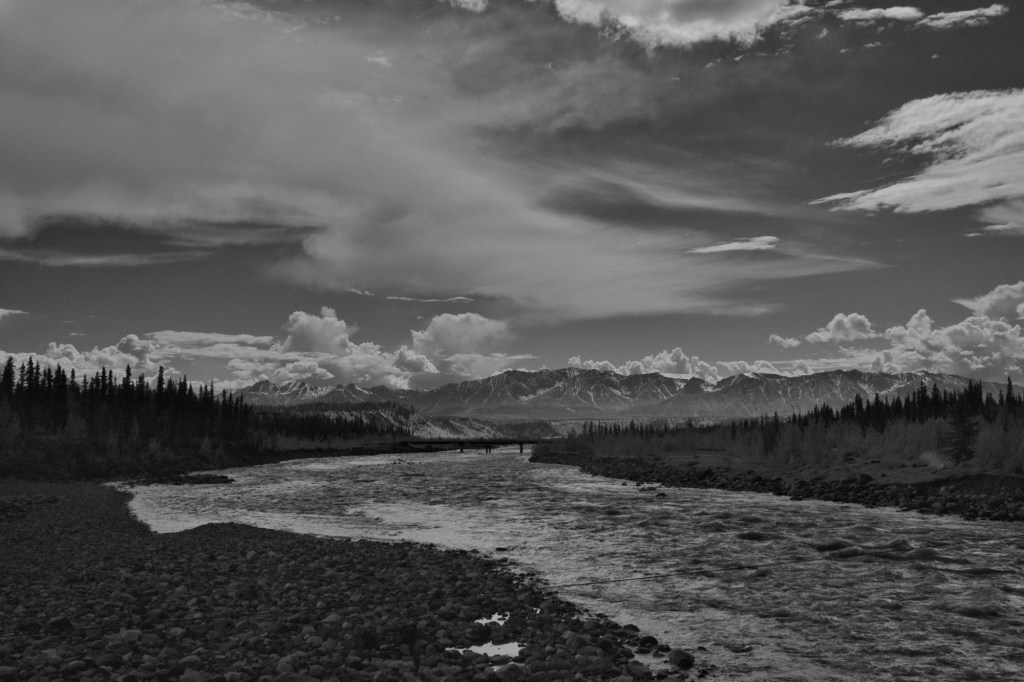
Today we drove into the heart of the Wrangell- St. Elias National Park- well Mark did. I think I mentioned before that Mark could win the Formula-1 race the way he drives his car. He singly handedly has redefined the image of a mini-van to be a “manly man” vehicle. But on to the business of the day. Our destination was the Kennecott Copper Mine, which is now a National Historic Landmark managed by the National Park Service. I will get into the mine in tomorrow’s post, today is going to be all about this magnificent park, and the unusual drive, walk, shuttle, etc. we took to get to the mine.
Wrangle-St. Elias is the largest park in the U.S. National Park system. It is 6 times the size of Yellowstone, and larger than the country of Switzerland. Now that you have a feel for the size of this park, it is also one of the most rugged, remote, and difficult to access. There are no National Park lodges here, no paved roads within the park, just two main roads, both gravel. We took one of the roads, whose condition varies as to whether it has been recently graded. The conditions can make the drive so rough that major rental car agencies specifically state that you may not drive their cars on the road. Welcome to the 60-mile McCarthy Road.
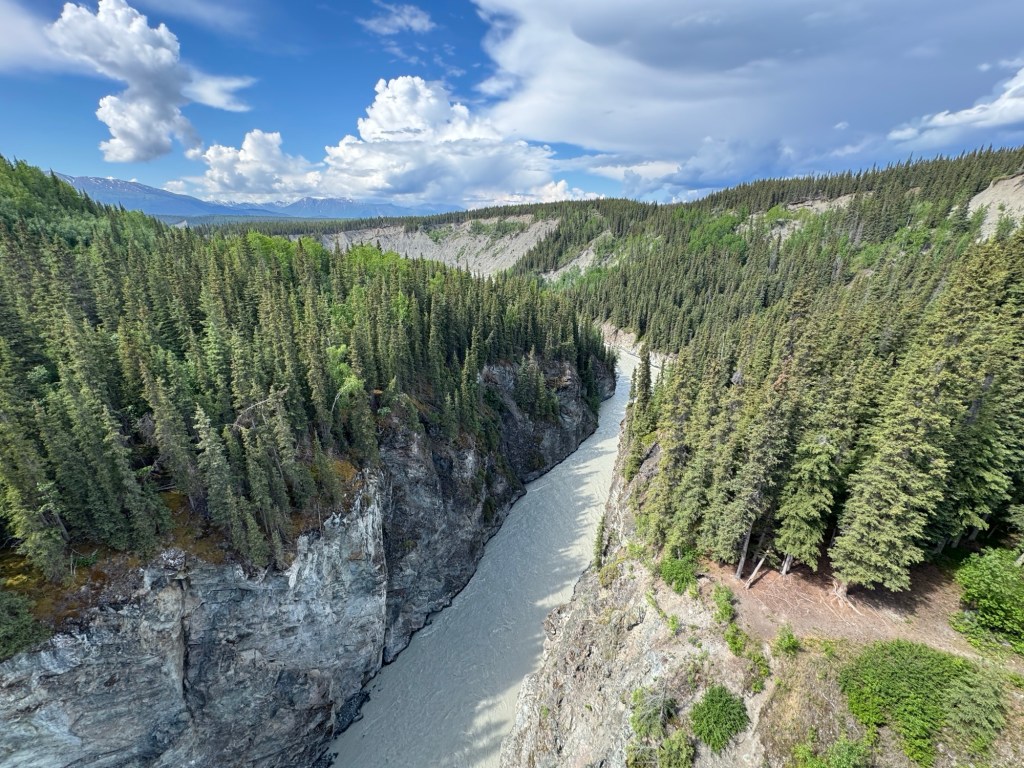
The McCarthy Road, wasn’t always a road. It was originally railroad track that carried the copper to a port in Cordova. But with many things, it wasn’t as simple as just laying tracks. They had to construct a $1.4 million bridge in 1911 to get the trains over the Copper River so they could continue on to Cordova. That is equivalent to $35 million in today’s money. But it was worth it, the Kennecott Mine generated $20 billion profits in today’s money. The 1964 Good Friday earthquake finally did it in. Today it is affectionately referred to as “the million dollar bridge”.
So, one of the things that makes the road so challenging is the remnants of the railroad. The Kennecott mine company pulled up some of the rails for recycling, but most of it was eventually buried under gravel. Unfortunately, the spikes were left behind, the cause for many flat tires, and some of the ties will poke through the surface of the road. We drove by a few today.
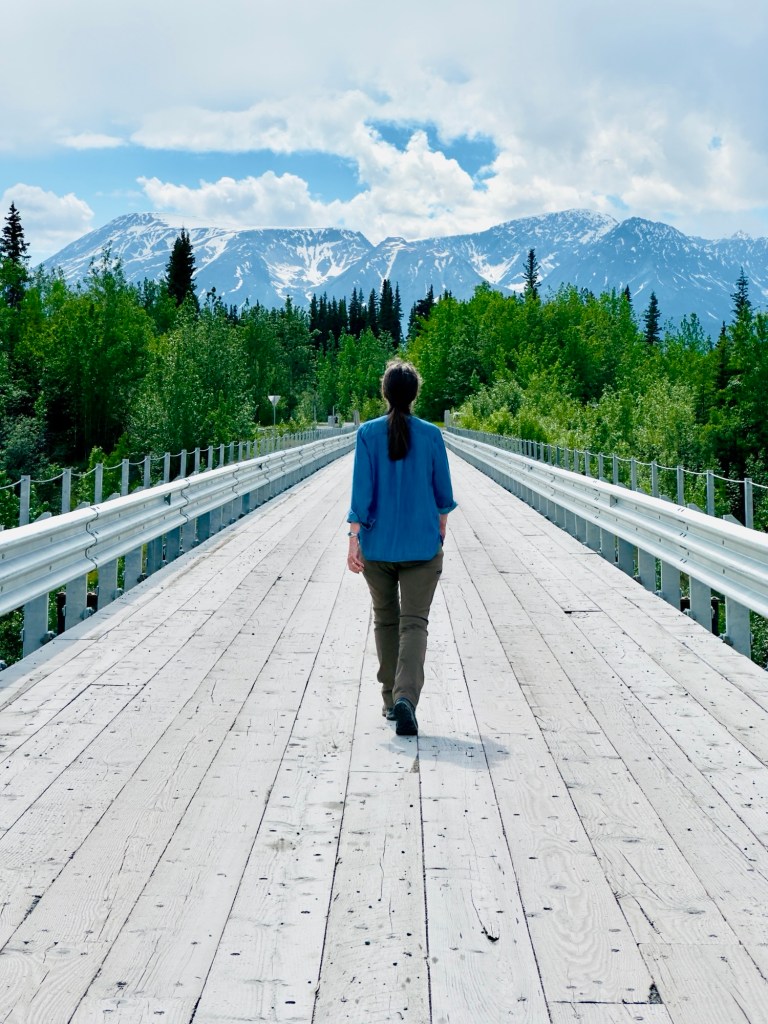
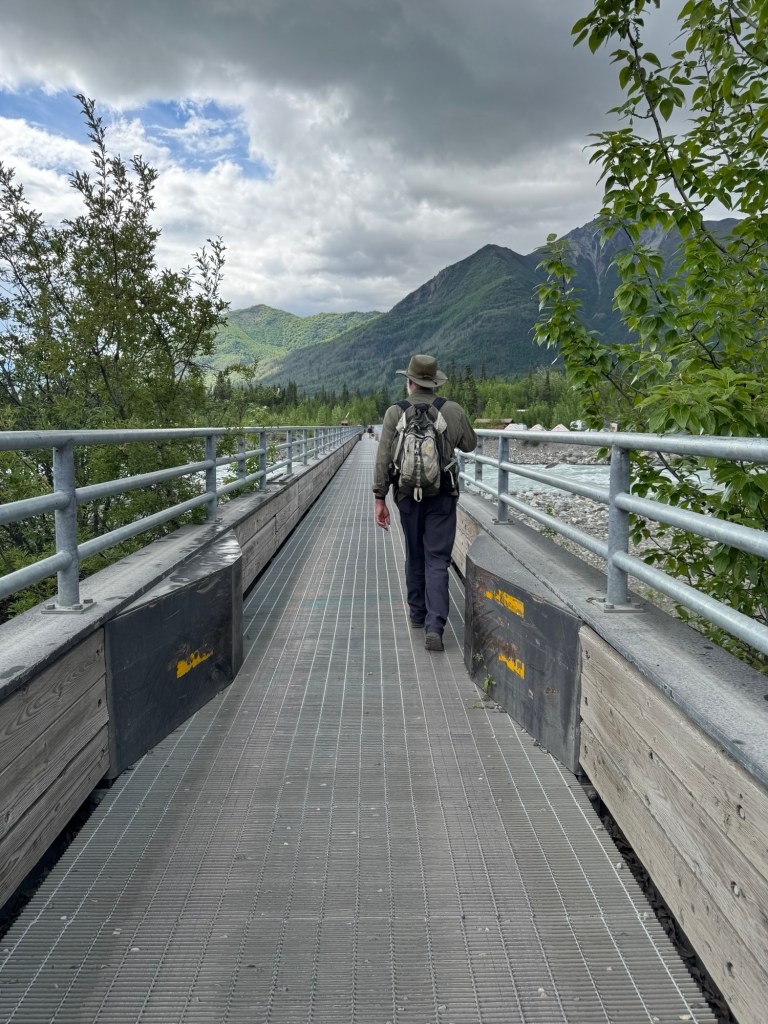
Once we got to the end of the road, you park in a makeshift uneven parking lot by the river, and truck your essential “must-have” belongings across a bridge whose floor is like a metal grate. It’s about 420 feet across a rushing river. But I’m not going to complain. As Mark, Cat, and Dave like to reminisce “in the old days” you would get in a metal ore-cart like thing benches, and hang from a cable. You sit in this thing, with your essential belongings, and use a rope and pulley system, that stretched across the roaring river, and you pull yourself (and aforementioned essential belongings across the river). Mark shared he brought his two daughters up here when they were toddlers, with their bicycles (see previously mentioned “essential belongings”), and pulled them across….together, because as he has qualified for me he was a young strong Alaskan manly man.
One last thing, there is an amazing visitor center for the National Park in Copper River Center. In fact, this was the nicest visitor center we’ve been too. There was a separate building for the informative, but questionably dry exhibits (I would love to rewrite these things for the park service, our national parks are so fascinating but the exhibits never seem to do them justice). My favorite display was a raised, eye-level diorama inspired scene with a bunch of animal crap scattered around. Below it was a set of drawers and pull up lids with an animal on each lid. There were about 6 animals: moose, squirrel, fox, rabbit, magpie, and an animal I can’t remember (I really need to take documentation photos). I immediately went to the moose drawer, opened it up and found….fake moose poop. This was helpfully provided so that you could find it on the eye level display. I mean, it’s memorable, looking at a pile of moose poop eye-to eye. Apparently some people find it difficult to tell the difference between moose, squirrel, fox, and rabbit poop – also on the display. Call me crazy, but I’m thinking a magpie isn’t going to leave a treasure as big as a moose.
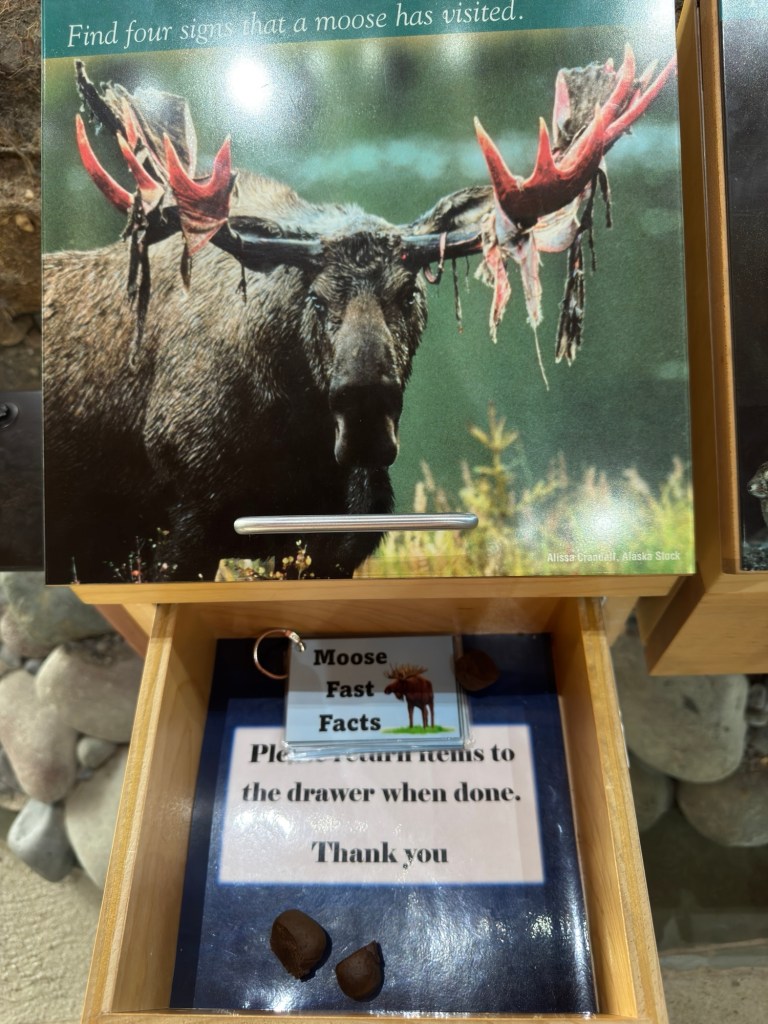
(Update: I shared with Cat the whole moose poop thing, to which she replied, “what shape was it?”…DURING HAPPY HOUR! As I found myself describing the shape of fake moose poop in a remote part of the world, I kept wondering “how did I get here?”, and “why am I talking about this?”. As I gave her my deer in the headlights stare (which she explained earlier this week the meaning of that phrase, especially from a deer’s perspective), she qualified the question, “were they round balls or big flat patties?”. I struggled to find the answer, again wondering “why?, please for the love of all things good, why am I having this conversation?”. For those of you who have stuck with me this long, I bet you’re curious (or if not, just pretend you are to make it worth my while to type of the answer). The shape and size of moose poop is dependent on the time of year and what the moose is eating. Winter poop consists of round balls because they eat bark (similar to a human diet of French fries). Summer poop appears in the form of flat fluffy patties because they eat leafy greens (like a human diet of green salads). If you take anything away from this digression, it is to eat more leafy green vegetables.)


Leave a Reply