
Today we dove deep into gold dredging in Nome. Over 5 million ounces of gold has been mined here since 1898. The gold here is “loose”; it’s not embedded in other material. You won’t find large gold nuggets lying around, mostly gold dust that has to be separated from sand and dirt. There was so much gold dust at the turn of the century, it could be found on the beaches. Anyone could pan for gold from the sand, no lease or mining claim was necessary. In 1900 over 20,000 people tried. After 5 years, all the easy pickings were gone and hardcore expensive dredging began. Imagine, five years was all it took to clear the ground of gold. Hand shovels were tossed aside, and huge buckets on a bicycle-chain-like apparatus were introduced to scour the frozen ground inland. It is with this background, I would like to introduce you to the industrial floating dredge.
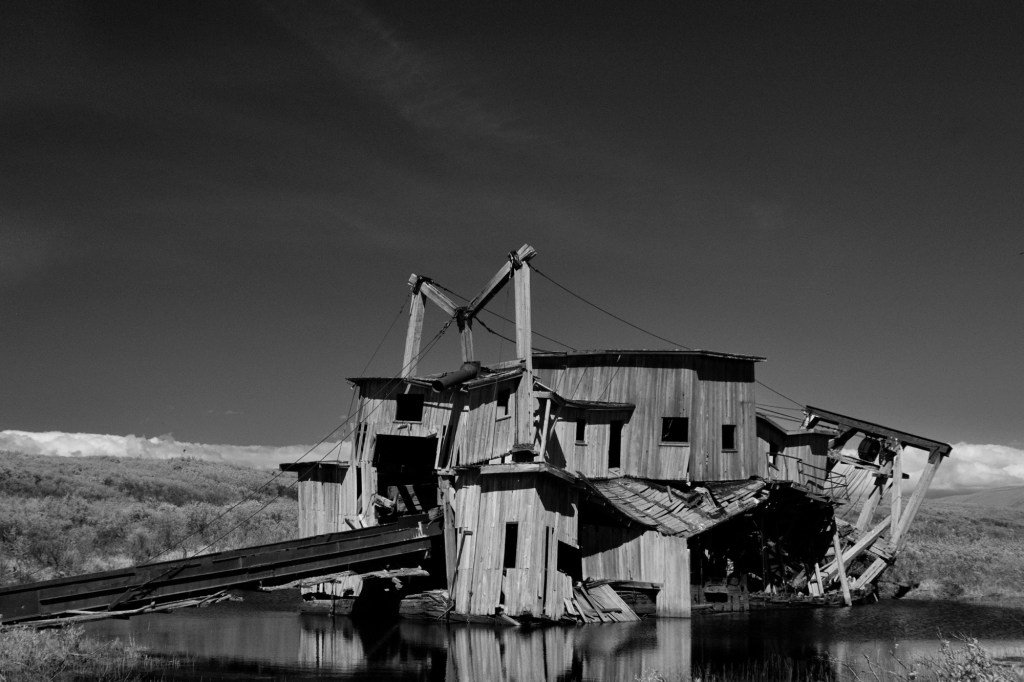
Dredges operate on the land and in the sea. Inland dredging throughout the landscape surrounding Nome officially stopped in 1963, and today you will find “ghost dredges”. These are eerie dilapidated structures that are every photographer’s dream. Those are the kind of dredges I am talking about today.
Dredges are huge, with some measuring between 14-16 stories. They are like floating skyscrapers that do a massive amount of damage as they move through the area. Ok, stay with me here while I try to describe how it worked. A team of people thawed the ground first so the dredge could dig. A large floating skyscraper was placed, and then surrounded by water creating on its own pond. As it moved forward digging, it would continuously re-create the pond. It would dig into the ground in front using 120 metal buckets on a huge chain that looked like it could belong to the bike used by the Jolly Green Giant. Each bucket could scrape up 9 cubic feet of mud from the ground. That is roughly equivalent of 9 bags of potting soil. That is 13,500 potting soil sized bags of mud every hour.
The dredge swung back and forth about 45 degrees digging as it went. It’s a similar motion to a windshield wiper. Water was used to separate the heavy gold from the dirt and all the extra detritus was spit out the back. Anything smaller than a 4-mesh screen can still be found in the tailing piles that the dredge left behind. If you decide to take up gold speculating, you are looking for something the size of a peppercorn or less.
Inland bucket dredging stopped for a whole host of economic reasons and environmental reasons. However, suction dredging still continues today offshore in the shallow and deep waters of the Norton Sound. Gold gurus come in the form of divers to place the suction hose, and boat captains are competitive. It such an interesting subject, that HBO Max/Discovery Channel has a reality show about searching for gold in the waters off of Nome. If you are interested, it is called Bering Sea Gold, and there are currently 19 seasons. Get some popcorn and an adult beverage and settle in.


Leave a comment