

**Queue up: Little Big Town’s “Day Drinking”

Whoah, what a night. I thought we would be just sampling a few tapas and then off to bed, but our guide Ellie showed us what food culture Basque-style was all about.
First of all, here they are not called tapas, they are pinxtos (PEEN-chos), and they most certainly are not a plate of olives. Ellie said people here are very social, they live in small apartments, and wander from pinxtos bar to pinxtos bar saying “hi” to people they know, getting a glass of wine, and eating their favorite little thing at each place. The name comes from the small skewer that many dishes are served with – it means to poke, or stab an unsuspecting spouse with the skewer when he’s misbehaving (I added the stabbing part).

We were supposed to go to 7 bars, we went to 4, and that was plenty. With Ellie as our front-man, pushing her way through the crowds, to the bar, yelling our order, listening for the reciprocating yell back of her name, and then muscling her way back to us with wine and snacks in hand. It was an awesome athletic feat to watch….from a distance.

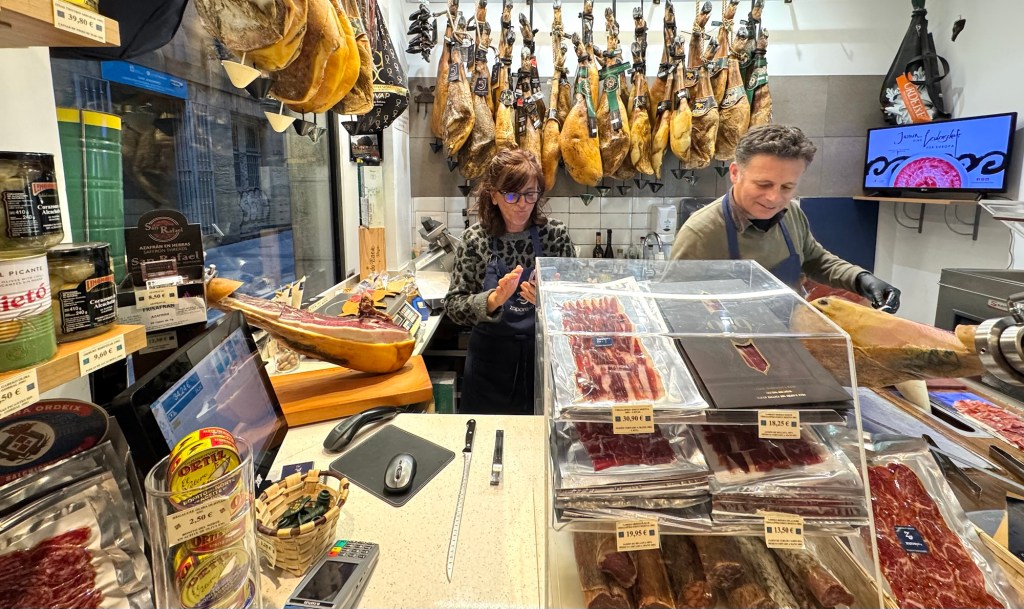
We also had an impromptu stop at a ham store owned by a very gracious couple that let us taste test (Peter’s favorite thing), black label ham vs. green label ham. I won’t go into detail about the different classifications, but here is a high-level explanation. There are two types of pigs, and depending on a pig’s parents they either get set out to pasture for a diet of 100% black acorns, or a partial diet of those highly-coveted morsels, and the rest of their diet is….well, I’m not really sure. The black label ham is the one you want, although you will pay a lot for it. By the way, I am not talking about the big round hunk of ham you see in the deli case at the Safeway. This ham comes in thin almost transparent strips, in vacuum packed plastic in the refrigerated case of a speciality market and costs an eye-popping amount for 4 ounces.
Another noteworthy stop was our cheesecake stop. Yes, there is a pinxtos bar known for that. You can blame Anthony Bourdain for putting it (and many others in this town) on the map. These “Bourdain” bars were very crowded. Ellie used to work at the cheesecake place, and said they made about 3 cheesecakes a weekend. Now they make 65 cheesecakes a day. We each had a 1/2 slice, which was the same size as a mega slice back home, and agreed it was delicious. Especially when you poured sherry on top (I know, sacrilegious for the sherry people in the south of Spain ).

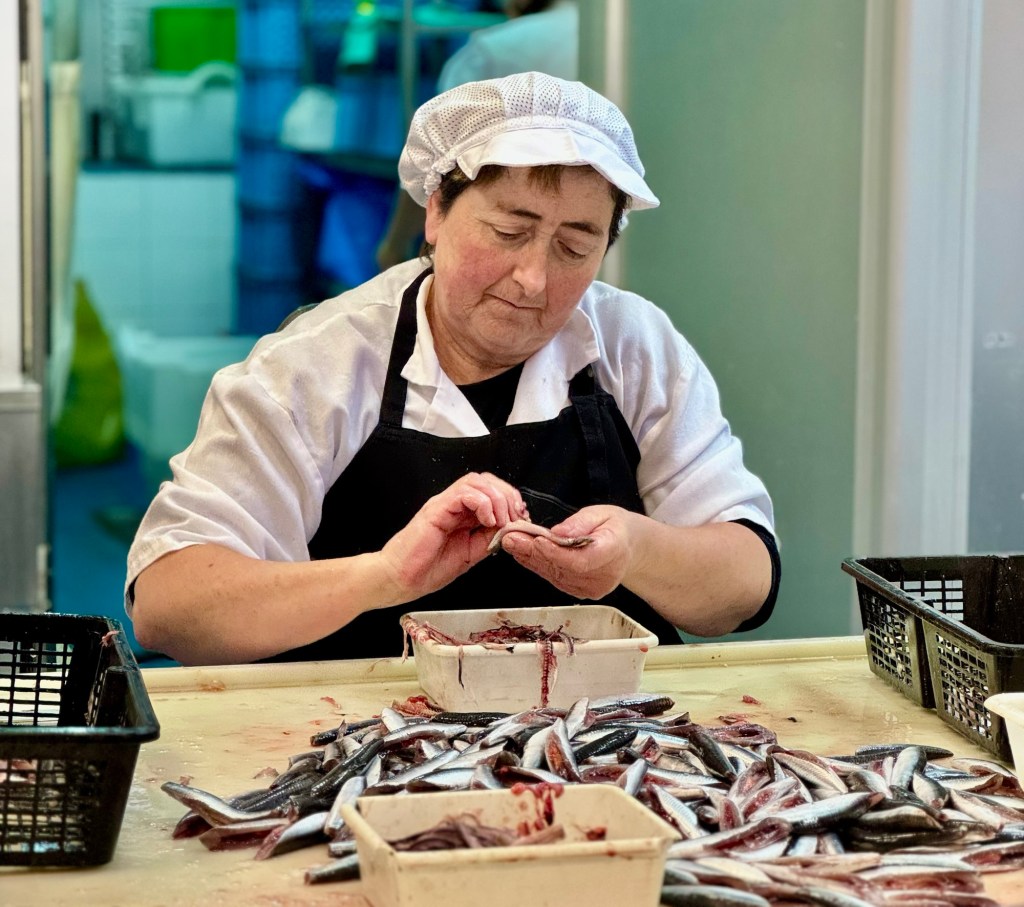
Ellie met us again this morning for a tour of some of the little villages along the coast. The rain followed us, AGAIN, so we had to improvise. Because we are at the height of anchovy season, we used this as an opportunity to learn about anchovy production. Forget about the canned anchovies you can get at home, this delicacy comes in every incarnation you can imagine. The jars of refrigerated fish are highly coveted.

After that thirst-producing experience, it was time for a little wine tasting of the local varietal, Txakolina (pronounced: Chocolina – like chocolate with an “ina” on the end. When Ellie first started talking about it, I thought we were going to a chocolate tasting). It is a salty carbonated wine that is poured from up high to help stimulate the carbonation. To be honest, I wasn’t so sure about drinking this wine when she started talking about it, but it was delicious. Cat said “pour in the first glass”, she didn’t want to dirty another one, and Ellie thought she said “pour a splash”, and I thought we were going to have another international incident. The wine gets its saltiness because the grapes are grown so close to the Atlantic Ocean, with all that salty sea mist blowing around. Unfortunately, they don’t export much of this wine, except for the rose, whose sole market is the US. Apparently on a clear day you can see France from the winery….we had to use our imaginations which have been getting quite a workout on this trip.

The people of San Sebastián love festivals. For example, there is one day a year reserved for drumming…..all day….on anything handy. Another festival is the shepherd and wet nurse festival. Yep….you read that right. It evolved from a dating tradition in the 1800’s. At a certain point in the lamb season, shepherds would come down from the hillsides and court nannies/wet nurses. It then turned into a big match-making party. And because others had FOMO of missing a party, they joined in whether they needed a significant other or not. In the 1920’s the Pope put the kibosh on the festival, and then it was resurrected in the 70’s. If you think I have had too much wine before writing this post, look it up….its a big deal.
Last item on Basque culture, they have their own language. It is the oldest language in Europe and it’s called Euskera. Ellie made sure we knew how to say thank you. You pronounce it “scary Costco”. How you spell it is a mystery to unfold for another time.

©Copyright 2025. All rights reserved. No reproduction of text or images without permission.

 pamphotography
Leave a comment