

Queue Up: Elvis Costello’s Toledo
What a day, we saw four out of seven of Toledo’s monuments, two Guinness World Record holders, Spain’s second best gothic cathedral, and ate some marzipan made by nuns.

Let’s get started. Yolanda met us at the hotel this morning. We arrived in Toledo and she drove us to different viewpoints outside of the UNESCO World Heritage site so we could photograph this amazing city on a rock almost completely surrounded by a natural river that was overflowing from the rains.
After walking through the old entrance arch, our first stop was the oldest mosque in Spain, dated from 999, Cristo de la Luz. It was repurposed into a Catholic Church in 1085. It has remained largely unchanged. I was struck by the red and white arches on the outside which were similar to those in Cordoba. They must have had the same designer, or it was a trend of the time…..


Before I continue, let me summarize the timelines of the different religions in Spain, in the most simplistic terms because I get a bit scrambled with all the dates, conquests, and really long names. First came the Romans (Christians), then came the Visigoths from the north (Christians), then came the Moors (Muslim), then came the Spaniards (Catholic).
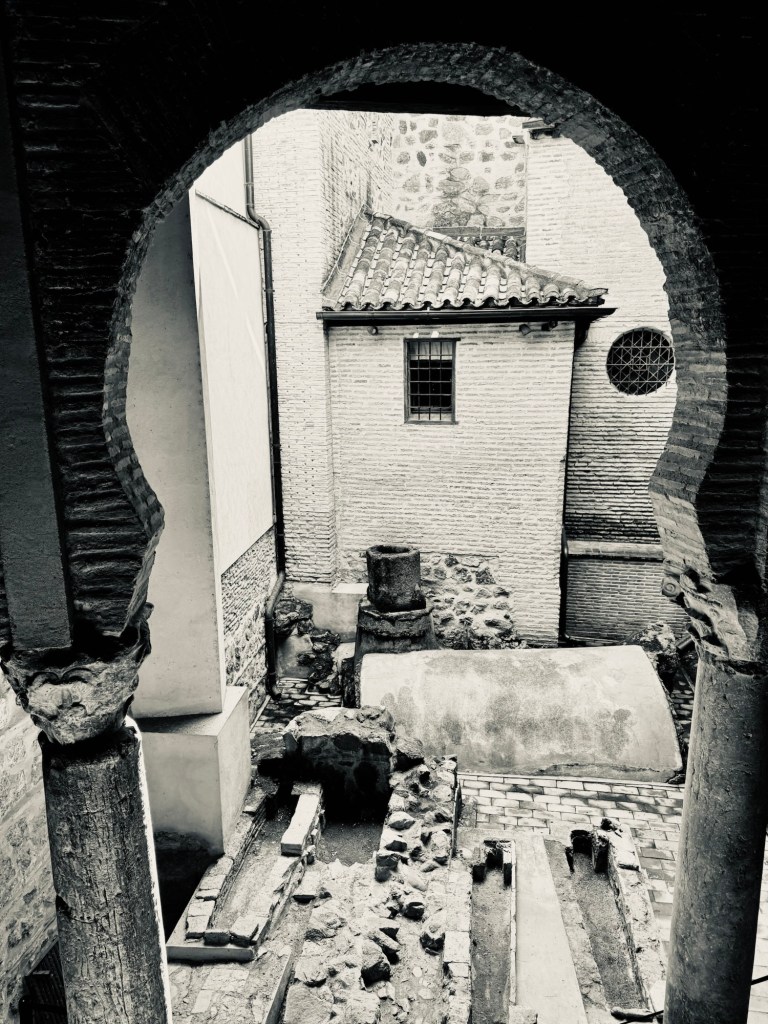
Ok, now we’re ready to talk about Inglesia del Salvador. This church has arches made of recycled Roman and Visigoth columns, with Moorish arches on top. It is cantilevered over the top of an excavation site of Roman ruins, complete with gravesites and tombs that were found with skeletons (no longer there, but don’t be disappointed, we stumbled on one in the most surprising of places). It gives a whole new definition to sorting and recycling used stuff.


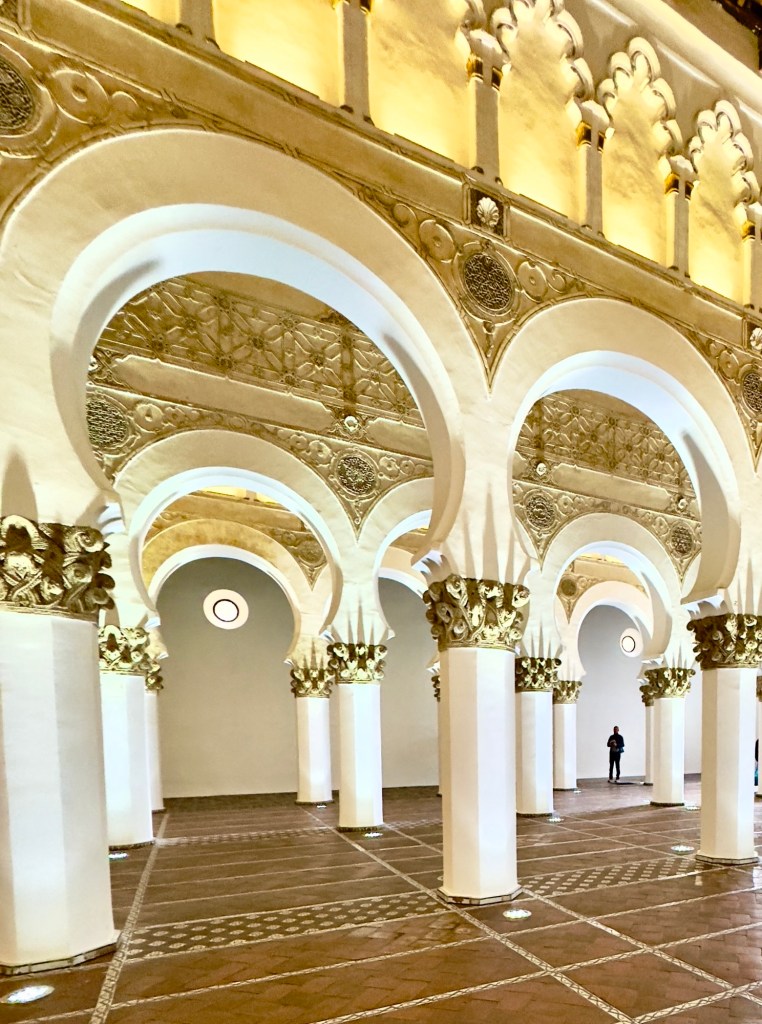
Next up on our monument tour is, Sinagoga Santa Maria la Blanca. It is the oldest synagogue in Europe. I have never been in a synagogue before so I don’t have a sense of the architectural styles, but this one reminded me of the Moorish columns and arches in Cordoba, just in white and gold. We had a few treasured minutes in there with only a couple of other people. It was my favorite stop of the day.

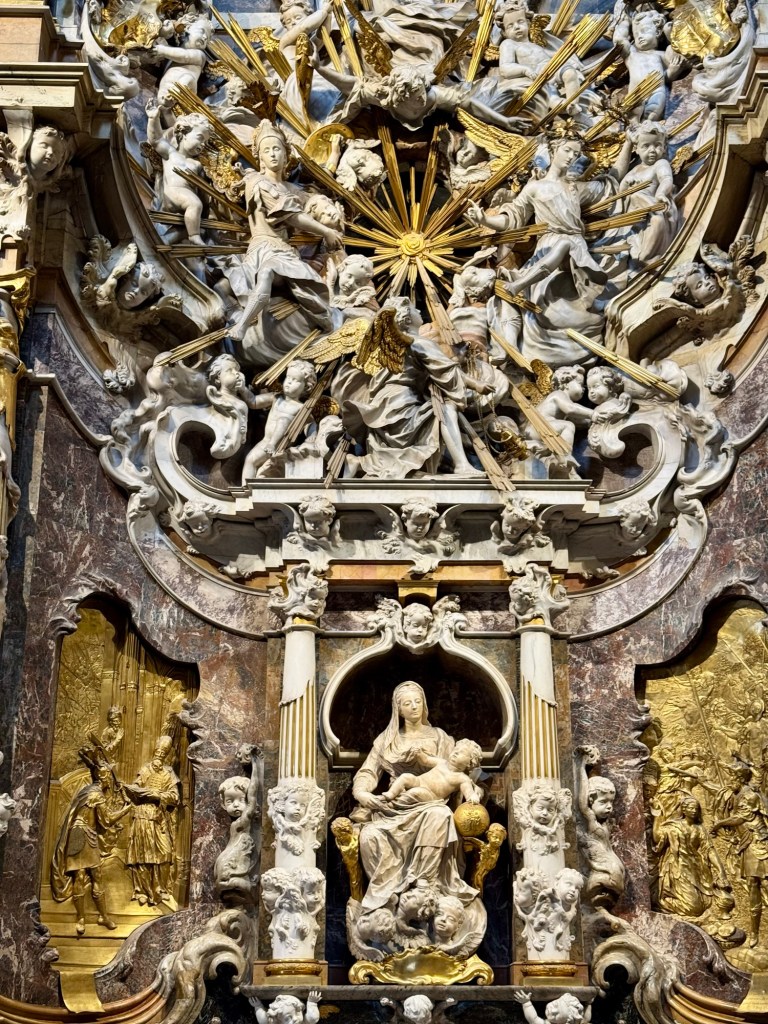
We can’t visit a historic Spanish city without seeing a cathedral, so we stopped at The Primate Cathedral of Saint Mary of Toledo (I’m really loving that Mary gets a lot of attention in Spain). This gothic cathedral was majestic, with fewer people than the one we saw in Sevilla (thank goodness). Behind their version of the golden bible alter, there was a Baroque style alter that, at the right time of day at the right time of year, it lets sunbeams through behind the golden alter to illuminate the Eucharist cross.

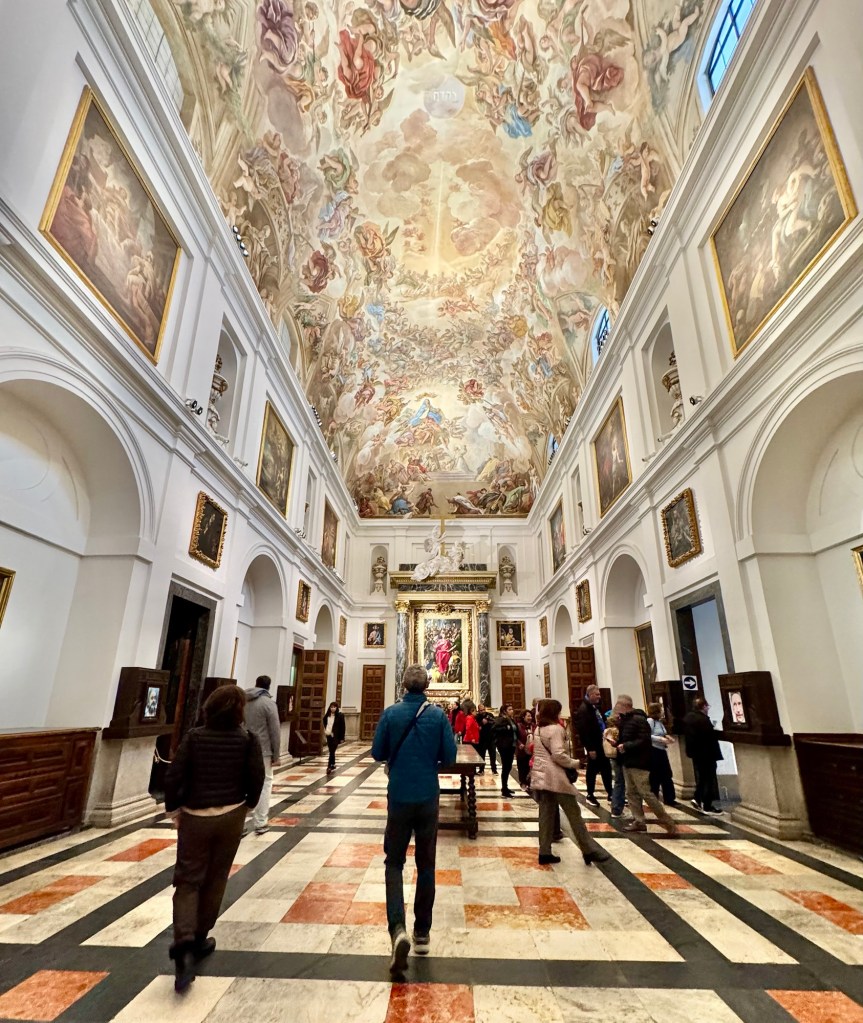
We saw the priest’s dressing room, which was as big as my house with huge dressers that spanned half a wall (they had many of these). Peter informed me that the priests have many different outfit changes and need all that drawer space. If I didn’t know better, I think he was laying the groundwork to pitch his case for more closet space. The artist, El Greco, painted a custom piece for this incredible closet that was 9 feet tall and 6 feet wide (The Disrobing of Christ). But the head honcho in the church didn’t like it and El Greco’s commissions were stopped.
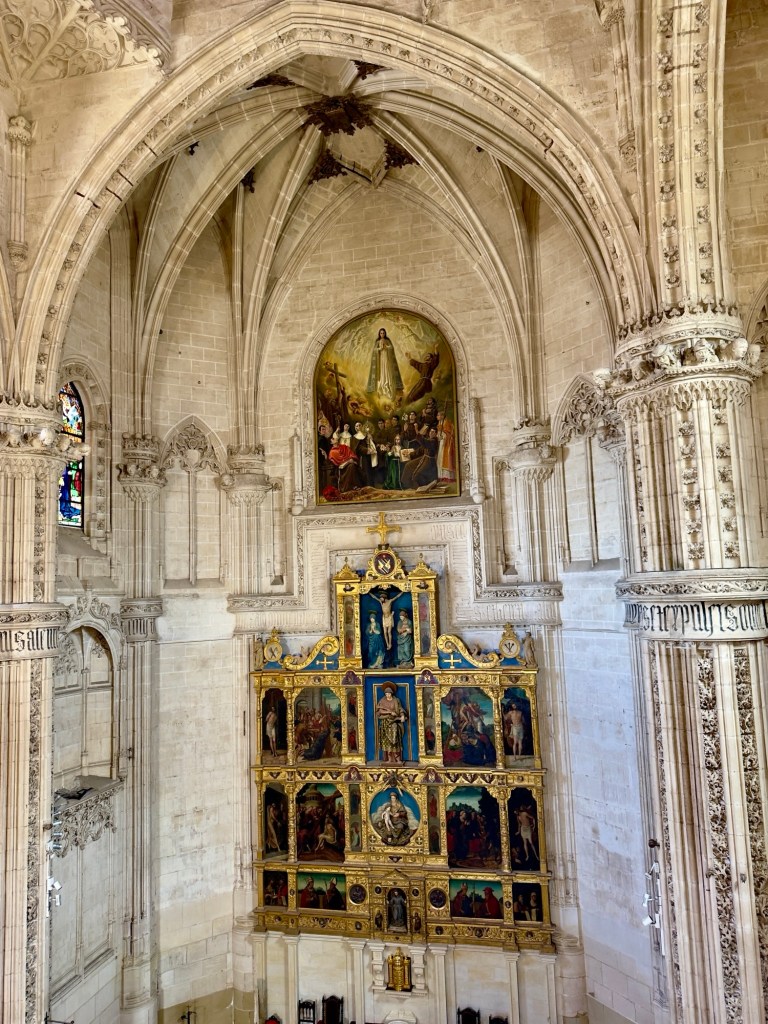
So far, I’ve recapped that we’ve seen a mosque, a synagogue, a cathedral, and a church that morphed through every religious period in Spain. What’s left you might ask? Good question. A monastery. Our last stop was San Juan de los Reyes. In addition, to walking the two story cloisters, we were able to access the balcony sitting area where Queen Isabella and King Ferdinand sat during mass. I have never been that high in a church and it was awesome to see the alter from that level (although difficult to get a good photo).



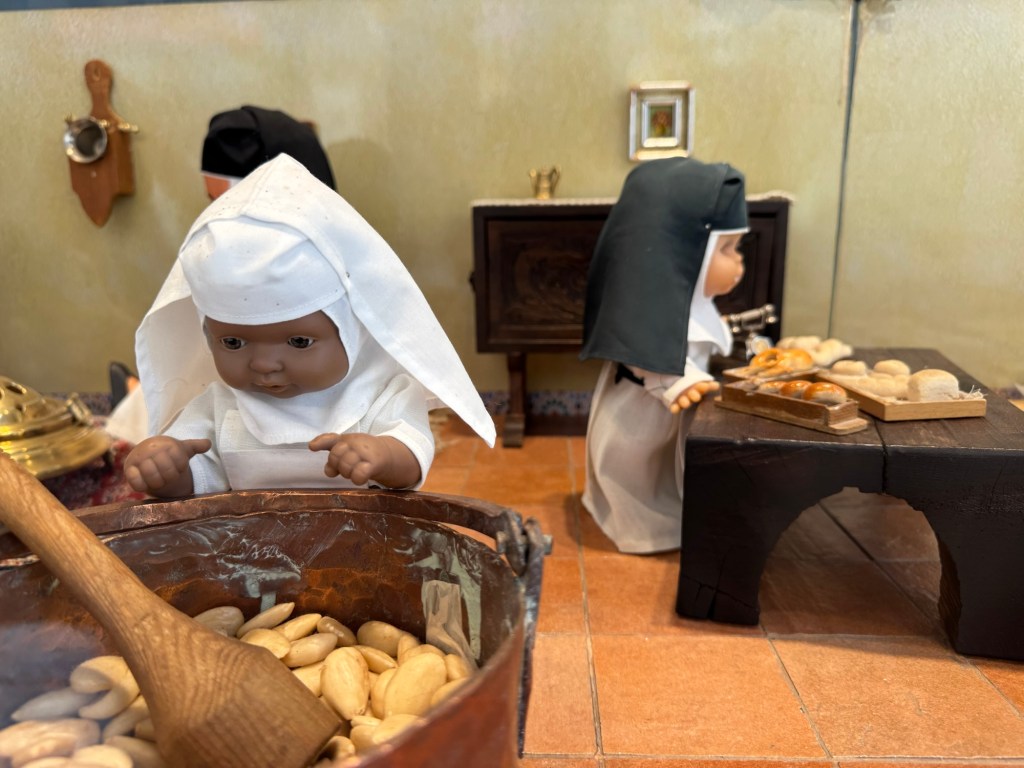
I’m sure some of you are saying by now “Mary, come on, enough with monuments, we want to hear about the Guinness Book of World record holders!”. The first one goes to the smallest window in the world. It was made this small to determine if you are friend or foe. I think it was the mid-evil version of a peep hole we have on modern doors. The second record went to a statue of Don Quixote made of marzipan (a mixture of almonds and sugar). It is 11 feet 9 inches tall. Now how it got that color, I’m not sure we really want to know. But we did stop and buy marzipan. It’s made by nuns down the street and was delicious. Who decided the statue was to be of Don Quixote and not perhaps someone else more noteworthy remains a mystery.


Tomorrow we leave beautiful Madrid and head north.
©Copyright 2025. All rights reserved. No reproduction of text or images without permission.



 pamphotography
Leave a comment