


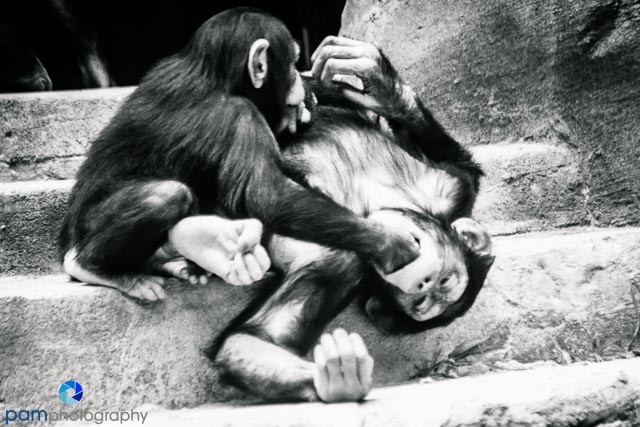
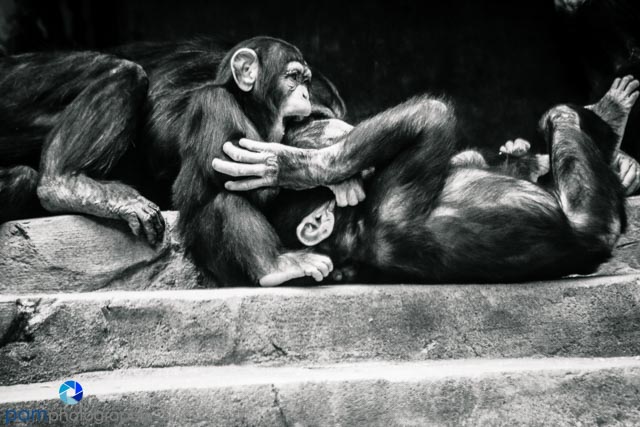
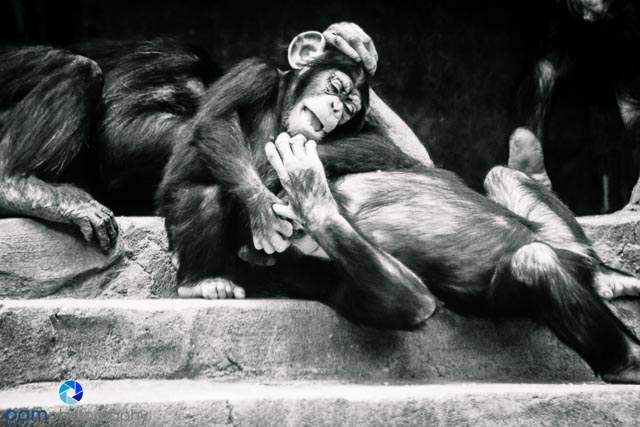
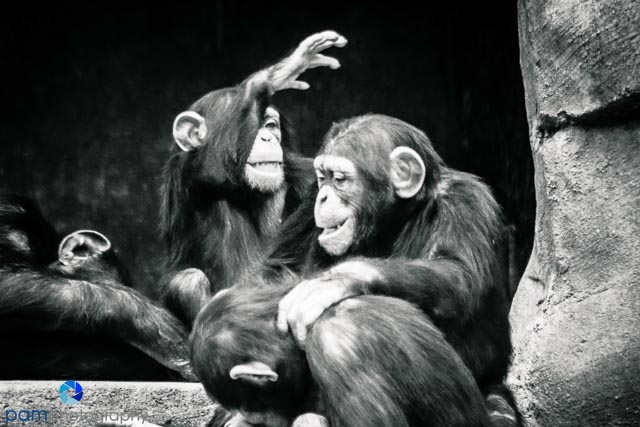
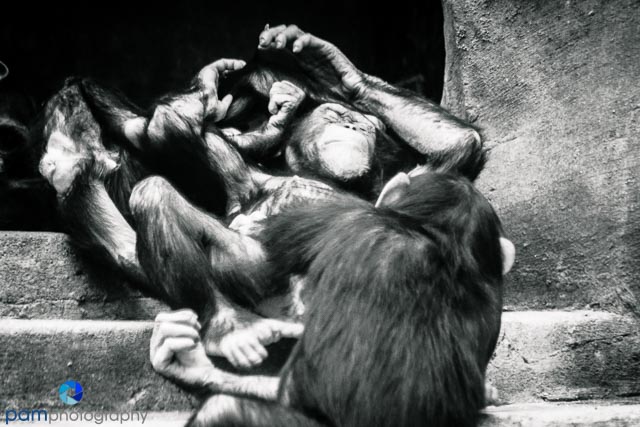
I write this post with some trepidation that I might stir up a debate about captive wild animals. I am personally conflicted every time I visit a wild animal park or zoo. I leave with a feeling that the animals should be free with space to roam, and also a much deeper appreciation for the natural world around me. My favorite time to visit the zoo is spring and early summer. There are usually baby animals, and I find the interaction of the “children” within their communities captivating. Peter and I visited the zoo twice in a week, and each time we spent about an hour watching and photographing the chimpanzees.
I think between us we took over 500 images. We just couldn’t stop. Every time we walked around the enclosure there was a different interaction, or a different expression, or a different composition. At one point we sat down in the viewing “amphitheater” and I realized that they were sitting in their own version of an amphitheater watching us as we were watching them. I was struck when an adult chimpanzee grabbed a burlap “blanket”, followed their active youngster around, and then set it down and the child laid on it grabbing its toes.
Tips
- Watch them for awhile. Try to anticipate movement and relationships.
- Look for expression. I find I gravitate toward expressions that resemble human emotion.
- Look for interaction. At one point the baby chimpanzee went to its mother for a hug and she seemed to bend down and kiss him/her. Unfortunately our angle was off for the shot.
- If there is quite a bit of activity, set your camera on burst or continuous shooting mode. Remember to change your focus setting so it will track the action and movement. Be prepared to take a lot of images that you will later have to weed through.
- For post processing, try changing the image to monotone. I find the backgrounds in zoos to be distracting, and drab.


 pamphotography
Leave a comment